
Put On Your Kicking Boots, It’s Time To Play Chess

Reading Time: 17 minutes

There is a saying that everything happens in three’s, in my case it was more like two’s. Two key events, some years apart, but both turning out to be significant, to me at least. The first happened in 1997, May 11th to be precise, the day IBM’s Deep Blue computer beat the world number 1 ranked chess player at the time; Garry Kasparov, in a 6-match series. The second event, took places some 18 years later on 24 October 2015, the day South Africa played against the All Blacks at the formidable Twickenham stadium in London, in the 2015 Rugby World Cup tournament in semi-final clash, and lost with 18 points to 20.

In a way I experienced both these events as traumatic but with mixed emotions; a part of me mourned the loss of something important, yet, on the other, valuable insights came to me as a kind of a comforting trade-off into the human condition. During 1997, now famous, chess game (which was later made into a film called Game Over), it became evident to me that the human brain could be beaten by computers – humans were officially not the smartest anymore. Any chess geek’s worst nightmare come true. Some years later in 2003, the famous Terminator franchise blazed onto the circuit, with their third edition in the series, entitled Rise of the Machines and it served as a stark reminder of the Kasparov incident.

The semi-final rugby match, the second event, in 2015, happened almost twenty years later as I, like many thousands of rugby supporters across the globe, were glued to their television sets, watching the fate of the Boks being determined by a wonderful back-and-forth kicking display of rugby talent. The majestic Dan Carter at the one end, seemingly unable to miss at goal, and on the other, a boisterous Fourie Du Preez launching one box-kick after the other, with a supercharged Brian Habana eagerly chasing down and cleanly catching the ball in the majority of cases; yet a spot in the finals for the Boks was not to be.

In my post-match sadness and frustration, I realised that, in spite of the loss, it was the tactical application of their kicking game that turned out to be such a strategic disrupter to the All Black’s game plan. I still think about how that game could have been different had Habana caught a few of those high balls at speed without being tackled…

One evening, some months ago, my wife and I agreed to a casual (dare I say friendly) game of chess, in which she unceremoniously gave me a decent whipping. It was then, ironically just right after I was beaten (is there a link between a good whipping and insight?), that I discovered the similarities between chess and rugby, and how, despite the best thought-out plans and strategies, we can easily come up short.

I also realised, as I did during my bearing witness to the two main events in 1997 and 2015 respectively, that kicking, if used strategically can win matches, but then, similarly, you also need an in depth and understanding of strategy, the kind of thinking you need to win a game of chess. Shortly thereafter I embarked on a journey to investigate, if a team could, through an improved understanding of the strategic elements of chess, used in conjunction with a solid kicking strategy, improve their chances of winning more rugby games. I think this is indeed true.

Attack Now Or Attack Later

If one argues that kicking is a tool that can be applied strategically, it is important to investigate how kicking as an element of play has changed over the past few years. One of the best benchmarks is the Rugby World Cup Series as it contains some of the best statistical data on the game, played at the international level, from 1987.

An analysis of the types of kicks, and their respective ratios, reveals that in the earlier editions of the tournament territory kicking was favoured with more than 50% of all kicks being long and deep. This is no longer the case as the box kick has become the number one favourite. Allowing defenders to re-organize and giving high-speeds wingers time to contest the ball, all while early on stopping any potential counter-attacks. One cannot help to notice that the touch kick, which ensures favoured and structured piece play, has remained one of the top 3 preferred kicking options.
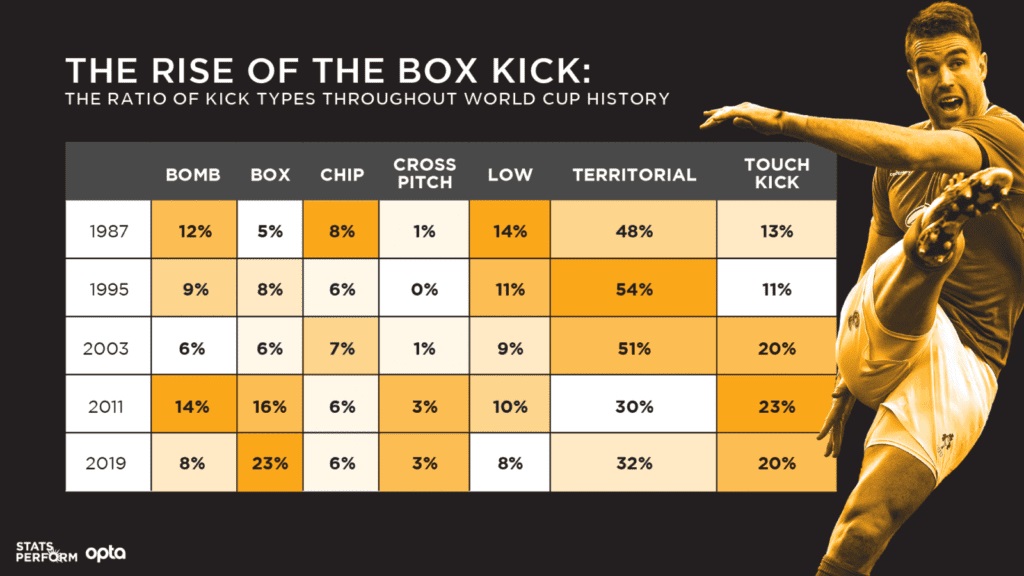
Statistics on the rise of the box kick

Kicking, while being used more as a “slowing-down of the pace” technique in earlier versions of the game, has become a catalyst for action to maintain or facilitate an attacking game plan. While it also produces points as part of structured pieces of play, and other moving elements such as penalties and free-kicks, kicking has become one of the main signals of a team’s intention to attack. The only real question left to ask, seems to be; when do you intend to attack, or rather how soon will you employ kicking as part of your plan of attack? More about this tactical question later (see Choose Your Weapons Wisely below).

Storming Castles On Horseback

Bob Simon, host of 60 Minutes, presented an in-depth interview in 2012, with world-renowned chess player, Magnus Carlson, currently the number one chess player in the world. Simon jokingly said about chess, “How can it be a sport, nobody moves, but many Grand Masters will tell you, it can be more brutal than boxing”.

Chess is one of those rare games which, due to its competitive nature and strategic requirements, seems to be a comparable fit with a number of other sports, if not all of them. Take for example Lance Armstrong’s8 description of world class road cycling and chess when he writes the following passage in his famous book, It’s Not About the Bike:

Nothing interrupts the high-speed chess match that goes on in the tight pack of cyclists called the peloton as you hiss through the rain and labour up cold mountainsides, swerving over rain-slick pavement and jouncing over cobblestones, knowing that a single wrong move by a nervous rider who grabs his brakes too hard or yanks too sharply on his handlebars can turn you and your bike into a heap of twisted metal and scraped flesh.

Chess is 2-player (represented by black and white pieces) strategy board game played on a checkered board with 64 squares arranged in an 8×8 square grid. After both players move, 400 possible board setups exist, after the second pair of turns, there are 197 742 possible games, and after three moves, 121 million. At every turn, players begin a distinct game, and each game evolves into one that has probably never been played before. The options of games are limitless.

The game of chess, by the very nature of all its pieces, reminds us that it is a game of war and strategy, with pieces named “Knight, Rook, Bishop, Queen and King”, to name a few, it stands as a stark reminder of some medieval bout of majestic and war-like proportions. At its heart, it’s a game of strategy with the intention of winning and outlasting your opponent.

Through calculated moves and advanced strategic foresight, one aims to force your opponent into a corner, while gradually limiting their options by taking their different pieces out of the game.

Besides strategy and the sound application of tactics, chess is also a game that requires intelligence. Magnus Carlsen, also described as the Mozart of Chess, instinctively knows what his next move is going to be, but he still takes the time to review his options and verifies his decisions. He once played 10 different opponents, won all of them all while playing blindfolded.

Yes, you read correctly, he never laid eyes on the boards or pieces. He memorised each board game with its different pieces and set-up. Absolute genius. A Grand Master such as Carlsen, claims he can remember 10 000 games of chess he played in his mind and he can see approximately 15 to 20 moves ahead. That is probably being as close to the maximum thinking depth for human-level chess.

While we can continue to unpack and analyse many more interesting facts, numbers, and stories about chess, I want to highlight four important similarities which are necessary to be successful in both chess and rugby:

  • Strategy – Both require a specific approach, philosophy, and strategy to the game. This means players must possess a deep understanding of the intended outcome of each game and what the key goals are for each game or certain elements of the game.
  • Game Plan – While the strategy is “the why”, the game plan is “the how”. Each player’s role, goal and objective are underscored and highlighted. The game plane provides the tick-box items necessary as the game unfolds.
  • Pieces / Players – Each game requires a firm understanding of every player / piece and their powers and functions, In chess, for example, a Knight can only move or be played in a specific manner, similarly in rugby the Hooker is responsible for the line-out throw-in and not the Outside Centre. Structure follows strategy.
  • Rules – Both games require a firm understanding of the rules and how they can best be applied and used to your advantage. Also, and very few times we think of this, but what happens to a team when any player or players breaks any of those rules? Think about the damaging impact of a yellow or red card in rugby for example.

I Am General…

When it comes to kicking, we routinely think of two, maybe three key positions namely Flyhalf, Scrumhalf or Fullback. These are traditionally the players that either kick the ball as part of the play to keep the game moving forward or secures points from kicking penalties and conversions. For many years the Flyhalf has been the assigned recipient of the title of general and key in determining the fate of the team.

The Flyhalf decides at key moments when to run the ball, when to kick for position and territory, or when to apply pressure on the opposition with box-kicks. Like a fighting general from his armoured vehicle the Flyhalf makes decisions in the heat of the battle.

Several star players can wear this prestigious rank with pride. Take for example Dan Carter (New Zeeland), top-scoring Fly-Half in international rugby, scoring a mammoth 1 598 points in 112 matches or the Jonny Wilkinson with his distinct kicking style, scoring 1 248 points in 97 matches for England, true masters of the kicking game. Many of the points from their marvelously accurate boots have led their teams to victories and championships.

In the South African context, there has been no short supply of kicking prodigy’s; take for example talented players such as Naas Botha (scoring 242 in 21 tests, impressive even by today’s rugby standards) of whom world renowned SARU President, Dr Danie Craven once said the following:

Dr Danie Craven

“Well you see, unlike most people would say a kicker, I don’t look upon Naas Botha as a kicker, I look at Naas Botha as genius, a player like Naas Botha is only born once in a few generations, if it’s a few, and not many”.

It is easy to see why Dr Craven thought so much of Naas Botha

Over the past years South African rugby produced many kicking legends in their own right; players such as Andre Joubert, Percy Montgomery, Morné Steyn, Joel Stransky, and many others. Steady players with even more steady kicking boots, many of them scoring the final points leading the Boks to victory, sometimes under immense pressure. Joel Stransky’s marvelously famous kick against the All Blacks in the 1995 Rugby World Cup standing in good stead as an example of such tenacity.

No matter how the game has changed or how and where kicking features in any team game strategy, it seems that we prefer assigning this role and task to either the Flyhalf, Scrumhalf and or Fullback. What is of utmost importance is to decide where, when and how these critical positions are supposed to kick.

Thinking back to the famous SA / NZ game I mentioned in the opening paragraph, I recall rooms full of people shouting in anger whenever Fourie Du Preez launched those Box-Kicks, and how we all groaned, yet we yelled in delight (or was it hope?) every time the ball landed in the safe hands of Bryan Habana, I guess we were all hoping for that one break, that one catch that just lands at the right moment in the ideal way to allow for a clean break-away run and a hopeful try – unfortunately that moment, although close at times, never came.

The key question, which I guess we will never answer is, was is it part of a kicking strategy employed by the Boks, or was it a desperate attempt by the men in Green and Gold, to try and penetrate an immovable All Black defensive line?

Of Kings And Queens

I was never going to be selected for the under 16 A team, I barely made the B team, and quite frankly, just being able to fit into a rugby jersey with my scrawny cross country built body was nothing short of a miracle indeed! Thinking about that now, we all looked like undersized primary school players and were always shocked at the size of our opponents. I always wondered what those kids’ parents fed them. With all of this in mind, kicking was our way of not being slaughtered or tackled to death. From that perspective it never occurred to any of us that we could, should in fact, develop a kicking strategy for our team; Who is supposed to kick? When? How?
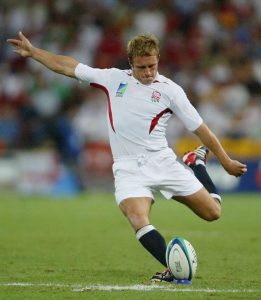
Jonny Wilkinson kicking at goal

Watching many of the live international games today, I have to state that sadly many of the international teams similarly don’t seem to realise the importance of having a kicking strategy, especially when senseless kicking results in giving away the ball. Possession sacrificed in lieu of territory. The type of back and forth kicking which seems to hide unfit forwards and non-creative backlines. Stale rugby games feeling remarkably like early round Wimbledon matches played on a Wednesday – just wetter and without strawberries.

A good strategy is not a single game tactic, but forms part of a range of other game tactics – that line is not from a rugby commentary, but from an article on chess tactics. Once again, rugby is not only a lot like chess, we are also reminded that kicking in the context of a rugby game, must form part of several other moving parts. We kick to achieve two main goals namely 1) to exert pressure (attack), or, 2) to avert pressure (defend).

Although we also kick to score points on conversions and to make sure we score on penalties, both aimed at strengthening our attacking position, we still need a kicking strategy. We can achieve the following goals by developing a kicking strategy:

  • We gain territory
  • We find and exploit open spaces
  • We keep the opposition away from a point-scoring range
  • We create variation in our game plan
  • We reduce the number of physical collisions
  • We combat or exploit good or bad weather and pitch conditions

Kicking Strategies are no longer just support plays but can be used as major tactics in teams that lack certain key elements of the game. Improved tackling methods, better line play, faster ball retention (all linked to stronger and faster players, irrespective of position) are continuously evolving. Kicking can prove to be effective, not only in attacking defensive lines, but also to exploit weak field positions, players, or tactical plays of the opposition.

A kicking strategy should involve all the different aspects of the kicking game and how it links up with field positions and team tactics and must include the following:

  • Exits – Clearing kicks to alleviate defence pressure
  • Territorial Gains – finding gaps and initiating turn-around plays
  • Winning the Kicking Battle – Methods and plans to win the psychological game
  • Initiating Attacking Plays – Tactics to increase points such as forced errors, drop goals, penalties, and conversions

In a TED talk presented by Garry Kasparov in 2012 (Don’t Fear Intelligent Machines: Work with Them) said that “In spite of 200 million positions per second, Deep Blue’s method provided little of the dreamt of insight into the mysteries of human intelligence”. A solid kicking strategy must always connect with this very same team intelligence and never become a stale matter of simple calculative repetitions, it should instead represent the tenacity and deep character of the team.

Choose Your Weapons Wisely

The 1995 Rugby World Cup saw some of the new laws in international rugby in action. These laws proposed changes to formation of rucks, stricter actions against high tackles, moving mauls and other set pieces of the game. To promote the safety of players and to make sure that each game continues at a steady pace and flow, these laws are constantly reviewed and changed.

Besides protecting players and improving the game, it has also influenced the way the game is played and how players are prepared and utilised in their respective positions. What we see today are specialised training regimens to produce better-rounded off players. Gone are the days that props can barely keep themselves upright in a tackle, and in some teams, props are some of the quickest men on the field.

Ball placed to kick at goal

The same rings true for the kicking game. The days of locks, loose forwards and all sorts of players kicking the ball away in sheer desperation, are long gone and teams that continue to play like this are heavily punished with brilliant counter attacks, often leading to tries or points in the form of penalties. Teams simply cannot afford to allow players to kick the ball as they wish.

As discussed earlier, the first thing a team needs to do in order to better control the kicking game is to create a kicking strategy, and secondly, to make sure the entire team has a clear understanding of the different types of kicks and their purpose. This is useful information to coach and recites to players during coaching sessions.

Here follows a detailed description of the type of kicks and their intended outcomes for each of them, for the benefit of players and teams:

  • Exit Kicks – A strategy used to alleviate pressure on defensive lines or to reposition a team further into their opponent’s territory. Try to get your kickers to kick with their balance towards the front foot. Give your kickers some breathing space by playing two or three phases first and position your main kicker in their kicking area of choice and skill. Don’t allow your opponents to catch you in a repetitive kicking pattern. Rather keep them guessing by switching between angles, using the different types of kicks, and following through by running the ball when least expected. Every player in the team must understand their specific role to play, once an exit piece is played, either by tackling, chasing, or hanging back. Don’t be caught napping!
  • Territorial Kicks – This strategy aims to move you upfield in the most energy-efficient way. Try, as often as you can, to find the pitch instead of being caught on the full. A critical success factor in this type of kick is the chase; let your opponents feel the pressure with enough runners chasing them down. Remember that pressure forces errors! Be regimented in who you allow to execute these precision kicks. Traditionally this will be assigned to your Scrumhalf, Flyhalf or Fullback. Two secrets to good territorial kicking are finding distance and hitting the wider channels of the pitch.
  • Kicking Battle Kicks – The kicking battle in most instances is a psychological fight and it is often the team that breaks the kicking cycle that ends up scoring with a solid counter-attack or ends up very close to the try-line with secured possession. There must be strong communication between captain and kicker to be clear when the ball is to be kicked again or run. If the ball ends up from touchline to the 15m line in the opposition’s 22, keep the ball in play. Played from a central location on the pitch, the option of attacking to either side remains open and keeps the opponents guessing as the fullback can’t cover both angles. Once again, is especially important that the entire team knows their roles. If the ball is retrieved within your 22, the best option is to kick into touch to regroup and play from a set-piece. Beyond the 22 creates a chance to counter-attack. The decision will be influenced by the available support players, ideally, aim for at least five. It should now be evident why knowing who chases, who stays and who falls back and protects the exit lines are so important. Keep a close eye on the opposition’s chase lines and the kind of pressure they create. Is the opposition chase determined and focused? Key factors that ease with the decision making to run or kick is the time left for play, the difference in scores and precise location on the pitch.
  • Attacking Kicks – About 1 out of 5 tries come as the result of attacking kick. The land of opportunity is often located just beyond the defensive line. These are handy kicks in cases where the opposition’s tackling and defense are outstanding. Attacking kicks need to be chased down to ensure the opposition is under such immense pressure that they lose the ball in the ruck and you regain control of the ball. Examples of good attacking kicks are the cross-field kick (mainly for the Wingers or Fullback to chase), the chip and reverse chip kick (mainly for strong running centres and wings to chase), the box kick (mainly for strong catchers and sturdy runner of the ball to catch).

Kick Mate

To become a Grand Master chess player, a player needs to achieve several performance ratings and win many games in different categories. You automatically qualify as a Grand Master if you win any of the world championship titles. In short, it means you must play a lot of chess and you must play against other high-quality players. As in most cases, it requires dedication, focus, training, and game time. It is a title inferred for life unless the player is ever found guilty of cheating in which case the title may be evoked.

However technical it may be to qualify as a Grand Master (GM) or an International Master (IM), it requires a firm understanding of the game, at its most profound and philosophical level, and one has to be a great player of the game. This means not only winning games but also playing at complex levels against other sturdy opponents.

From within the technical structure of high-level chess, three main strategies are taught in the game of chess, and they are similarly applicable and comparable with the game of rugby, specifically where kicking is a key tactic.

The three main strategies19 that apply in kicking in rugby includes the following:
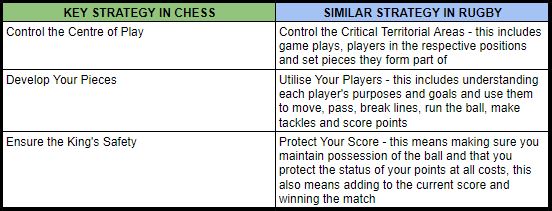
Comparing chess and rugby kicking strategies

Winning at chess, as in rugby is not only about understanding how to play the game, but how to manipulate and amplify those parts of the game that proves most effective and beneficial. No strategy or plan is of any use if it does not create the right kind of opportunities that win matches. This means that to be successful at either of the two games means that we must master multiple elements in a game.

As we have seen in several cases, kicking is one of those keys that can unlock playing potential and cause the required disruptions needed to score points and win. Our understanding of both strategy and tactics will be most helpful when it comes to achieving success.

Dungeons And Dragons

In the 70’s and 80’s a famous board game was developed by Garry Gygax and Dave Arneson known as Dungeons and Dragons, or D&D (or DnD) as it is more famously known. The game was derived from miniature wargames with a variation of the 1971 game Chainmail serving as the initial rule system. The game is recognised as the beginning of modern role-playing games and the role-playing game industry. It is still played and enjoyed today although several new editions exist.

One characteristic about this game is its ability to play on the creative imagination of the players, and the dependence on each other’s wits, to go beyond their circumstances and get them out of trouble. The lucrative idea of going on quests and adventures turned out to be more than just the prowess of intelligent Science PhD’s as was portrayed in several The Big Bang Theory episodes, it also has something important to teach us about game plans and strategy.

The main principle of the game is that players can create their own characters with character and personality traits, skills and even a moral code, or set of principles the character abides by. In true D&D fashion, the game is the culmination of imagination and strategy. The game is regularly played in team format where group players will embark on a quest. Their skills, wit and wisdom will see them through the challenges in their way. Sounds familiar? Yes, D&D is indeed like chess and rugby.

The rules of the game, as in rugby and chess, determines, to a great extent, the behaviour and decision making of all characters and it inevitably influences the course of the game. A set of principles on how to play the game, and how to apply them to the variable set of circumstances, is what makes this game so popular. In similar fashion, the rules, the environment, the nature of the players and several peripheral factors, influences the outcome of each game.

Ending off this piece about the importance and specific intricacies of kicking as a strategic tool and tactic in the game of rugby, is governed by a range of short principles, and presented below as a bulleted summary:

  • The type of kick is determined by the intended goal in mind
  • There should be no kicking without an approved Kicking Strategy
  • Decides who kicks, stick to it, and the entire team must in support of this
  • Kick when it fits into the game plan

In the final analysis, kicking as a critically important element of the game, must be applied strategically and with common sense. While kicking is a perilous game changer, this much we have seen, it remains a dangerous game tactic that can bring about success to any team if it all can come together on the day.

In spite of our best intentions and kicking plans, we are fortunate to be reminded that the game is still played by 15 players, unless of course you were one of the All Blacks back in the 1995 Rugby World Cup semi-final, when a fax22 arrived which read: “Remember that rugby is a team game, all 14 of you make sure you pass the ball to Jonah!”.

Ivan Oosthuizen

Ivan is a freelance writer and specialises in creating digital content for clients on marketing, branding and thought leadership within the Medicine, Healthcare, Senior Living and Mental Wellbeing sectors. Ivan has more than 20years of senior and executive management experience in various industries, and can be contacted pencilthis.com
Why do New Zealand Play More Rugby in 80 Minutes?

Reading Time: 13 minutes

Let’s be honest, we all love the exhilarating feeling of winning, but when the underdog takes a win – we go ballistic! In few other sports is our hunger for winning, and our respect for good sportsmanship, so prominently juxta proposed as in the game of rugby. We encourage our teams with gut-gurgling shouts, role-play scuffles in pubs packed with our best mates, followed by roaring war-cries of “yes, yes, yes” when our team finally dives in for a try under the uprights. It’s a thing of beauty, really. Ask any hardened fan or ex-rugby player and they will concur that rugby is not something you watch – you live it; it pulls you into a world where we you can’t help but cheer and shout, and jump up and down.

There’s Only One Dog and That’s The Underdog

In all fairness though, not all teams are created equally. We watch average games, good games and then clashes of Titanic proportions, and I don’t mean the boat. International rugby games offer a certainty that we are in for a treat, which is why test rugby is the queen of all matches; you know it’s going to be tough, tactical, technical, and tense. You can also count on the greats and their tell-tale playing styles such as the French flair, the Bok brutality, the tenacious loose mauls of the Pumas, the lighting fast line-breaks from the Wallabies or the scrumming physicality of an English pack of forwards.

It all feels rather predictable in a way, but there is one team who seem to play in a class of their own; I am talking about the All Blacks. Those marvelous players of the game, who just seem to possess an almost mythical presence and a fine-tuned perspective on the game, always just that one strategic step ahead to the rest of the world’s national teams. Why is this the case? To give a good answer, we need to unpack this question and get a better understanding of how the game of rugby has changed, more importantly, how New Zealand continues to dominate international rugby and why they constantly create new styles and structures of play.

Beauty is Pain

However inevitable change is in our world, it is indeed constant and sometimes it can be the cause of remarkable improvements. Rugby as an international sport, is certainly part of a greater global-culture and the game has been influenced and changed in several ways. Think for example about the different styles of rugby played in Northern and Southern hemispheres. A study of the latest game statistics taken from the Rugby World Cup stats, since its inception in 1987, reveals critical elements and key plays of the game which have indeed changed, some intensely more than others.

Looking at two elements (and there are many more) namely ball-in-play time, and game intensity, we can observe noticeable changes. The 1987 (25:45) and 1995 editions both saw less than 30 minutes ball in play time, 2003 saw just 31:58 minutes of ball in play time, compared to 32:12 minutes in the 2011 cup, and 34:21 in 2019 – that’s a 33% total increase. This dispels the myth that set pieces slow down the modern game and that we see less live action. The physicality of the game has also changed considerably, and players need to display greater levels of fitness as the modern game is physically more demanding with longer periods of uninterrupted play. Comparing the 1987 Rugby World Cup team averages with that of the 2019 series, we note that carries increased by 32% (86 to 115), tackles by 166% (from 48 to 129) and rucks by a staggering 230% (from 25 to 82).

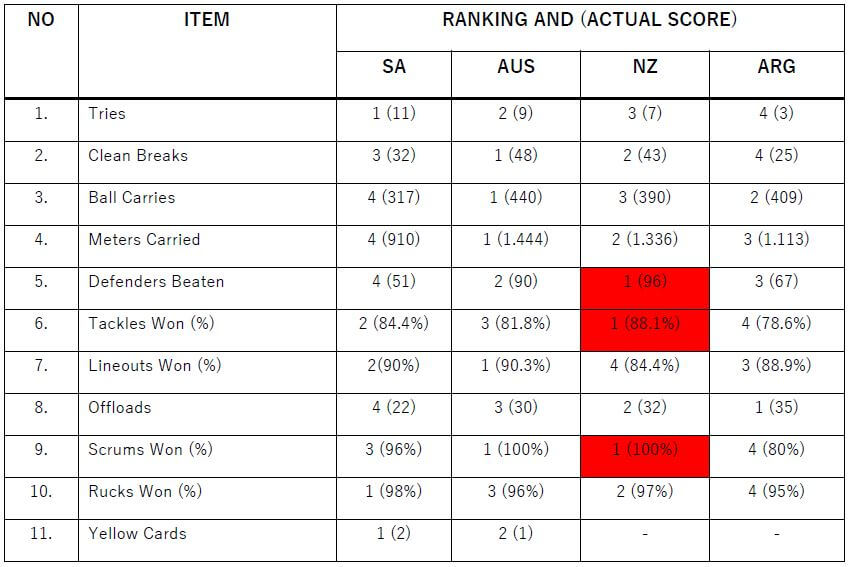
A comparative analysis of the Springbok, Wallaby and Puma team performances (taken courtesy of the 2019 The Rugby Championships Stats website), ranks the All Blacks against their peers as follows:

2019 Rugby Championship Stats

If we look at the All Black 1st and 2nd placed rankings in the table, it’s evident that the team excels at actions that promote movement, speed, and work-rate. A review of some of the New Zealand based Super Rugby series team stats, follows a similar play-pattern. The All Blacks are clearly great at running, cutting defense lines and stopping attacks, but they seem to perform poorly in other momentum building facets of the game, we would traditionally associate with fast work rates and high volumes of play, these include line breaks, ball carries and quick or short line-outs.

How is it possible that the All Blacks can continuously dominate and play games that create more scoring opportunities, score more tries, generate higher work rates, and more importantly, consistently play each game as such formidable opponents, when the stats tell us a different story?

Is it possible that the secret to their rugby success has less to do with their game tactics and techniques, but that instead, their overall approach and philosophy towards being an All Black player is at the heart of their energy and abilities to generate such high velocity rugby?

What follows is a look into what I believe to be the deep seated principles contained in the All Black psyche, and what is potentially the door that leads to the treasure room of these amazing athletes, and what it really means to be a wearer of the Black Jersey.

X Marks The Spot

In his famous book Legacy, bestselling author, speaker and business consultant, James Kerr, reflects on some of the elements that make the New Zeeland national rugby team one of the best in the world and writes about their principles of leadership, which have been widely adopted and taught across the world, and how it can be applied to business and life. For Kerr, being an All Black is not just about being a rugby player, but one of the ultimate sports achievements. Kerr became a successful business and leadership consultant by developing leadership and change solutions for prominent leaders of world-class teams and organizations, based on the close analysis of the All Black’s focus on principles, their demands from players, leadership and their winning mentality.

According to Kerr, the All Black Team approaches their rugby with a specific game plan and they employ numerous tactical approaches, principles of leadership, life and businesses strategies, and they meet their opponents well prepared and versed in their own game plan and main strategy. A team that wishes to replicate their in-depth structure and well-prepared execution, will need to possess exceptional tactical skills. An opponent’s game plan also needs to be so much more than just key moves, magical line-out calls and code words, it has to contend with the All Black’s game plan which can be summed in two words – arrive prepared.

This Is Sparta!

Without sounding as if I have a royalty agreement with Kerr’s book sales company, I will confess that the book’s opening lines in the first chapter called Character, will cover even the most anti-All Black supporter with goosebumps. With due reference to Kerr (see the link in footnote above if you wish to purchase the book, I can highly recommend that you do), I can’t help but quote a few direct lines taken from Kerr’s book – doing anything less, won’t do it any justice! The chapter is based on a test played at Dunedin, on 19 June 2010, between New Zealand and Wales. On page 3 and 4 Kerr writes the following:

As the jersey go on, so do the “game faces”. The players become All Blacks.

“I can still remember Richie McCaw’s first jersey,” Gilbert Enoka says.

“He spent about forty-five seconds to a minute with his head just buried in the jersey.”

Today is McCaw’s ninety-first test.

“A win today against the Welsh is not enough,” says a pundit. “It has to be a big win.”

In the stadium beer cans rattle against the hoardings. A helicopter thumps overhead. Someone sells T-shirts.

McCaw Steps off the bus. There is a cry, a pöwbiri, the traditional Māori welcome. A lone Māori male with a taiaba, a thrusting spear. There is an explosion of camera flashes.

McCaw accepts the challenge on behalf of the team.

Woman swoon. Men too.

The All Black head for the sheds.

If you swooned too, that’s ok, it is an intense piece of writing about the depth and sense of pride, let alone the experience in real life. My first introduction to the All Black presence, dare I say, mystical presence, was many years ago when I witnessed them perform the famous haka, the well-known pre-match war cry. I was but about 10 years old. While many teams have responded in impressive and sometimes less gentlemanly ways, the idea that opponents stand their ground and face the haka stunned me into adoration. Who in their right mind would want to rugby against these guys after that?

I recall my own boyish marvel and fear upon staring down those battle crazy eyes and an earlier version of the haka, which ended with the team jumping
into air. I still remember, even as I am thinking about it now, that it was like they were preparing to fight, to do battle, to conquer. The closest I ever came to feeling a similar sense of combat come over me was when I heard the famous, almost cult-like line, from the movie 300 when King Leonidas, sends a Persian messenger with a flying kick to his untimely death down a waterfilled pit, while shouting the now famous “This is Sparta!” line. While the All Blacks may not be Spartans, they sure came darn close to sounding like the legendary and brave warriors!

Why Does The Rabbit Smoke His Pipe?

The Cree, is a famous tribe of approximately 350 000 Indians, either alive or with some ancestral links, residing in Canada for many years now, and have been for several generations. The tribe, less known at the time, was made famous when Sir Anthony Hopkins played the role of a highly intelligent billionaire (Charles Morse) camping out in a Canadian cabin with a group friends for a weekend in a praised film called The Edge.

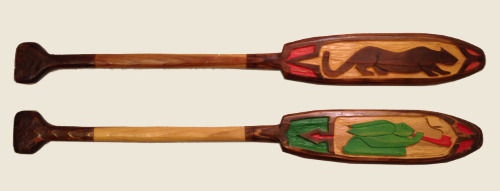
Upon arrival Morse must solve a riddle presented to him by one of the local town’s men. The man holds up a paddle depicting a panther on one side, and asks Morse what is depicted on the other side of the paddle? Being the well-read man he is, Morse answers “A rabbit smoking a pipe”.

To the delight and of his entire entourage. Someone from his crew asks him why the rabbit smokes his pipe, to which Morse answers, “On the one side is the Panther, on the other side his prey, the rabbit, but he is unafraid – he smokes his pipe”. The local town’s man then asks Morse, “Why is the rabbit unafraid?” There is tangible silence when Morse replies, “The rabbit is, unafraid – because he knows he is smarter than the fox”.

The rabbit smoking the pipe

This Cree fable perfectly sums up another key element present in the All Black psych – they know they are smarter than their opponents. Knowing is different from believing. Knowing comes from a place of conviction, a cavity where the possibility of an alternative outcome doesn’t exist. It is from this place of personal confidence that the All Black team walks onto the pitch.

The other component, based on the same fable, is the rabbit’s traits of speed, prowess, tenacity, and character. The rabbit is faster, more innovative, more cunning, more mischievous and knows, well in advance, about the presence of the panther. The hunter becomes the hunted. The realization brings peace of mind and allows for a calm demeanour and more time for creative thoughts to flow. It’s this magical combination of work-rate, energy, conviction, and confidence that creates unstoppable momentum. The team who wishes to stop such an onslaught will have to outwit the rabbit.

Show Me Your War Face

1979 saw the publishing of small novel by Gustav Hasford (Bantam Books) called The Short Timers. It would later be made famous by world renowned director and screenplay, Stanley Kubrick in a film called Full Metal Jacket. Besides being wonderfully written and made with Kubrick’s attention to detail, the movie also boasts one the best opening scenes of all Vietnam war movies with a 20-minute continuous rant by the famous drill sergeant (explicit language, parental guidance is advised). During one of these early morning encounters the drill sergeant instructs, in a shouting voice, to one of the recruits to show him his war face. Try as hard as he wants the recruit just never quite scares the sergeant, his unquestionable effort is a moment of military humour at its finest.

While the movie is all about going to war, learning how to become an angry killing machine and how to find your inner warrior – the exact opposite is what makes the All Black team exceptional. Team players are early on taught about the principle of red heads and blue heads; a simple yet effective way of depicting the two choices of play when under pressure. A player can either act like a red head – be all over the place, and let your emotions get the better of you and shroud yourself in acts of frustration and temper tantrums (especially when you are 12 points down in the last quarter), or, you can decide to apply a blue head, which represents staying cool, calm, collected, focused with your emotions under control. What this translates to, in rugby terms, is that a winning team can master their emotions and control how they behave. This principle is deeply entrenched and is far more than the measly application of the “let’s maintain discipline” mantra, or even worse, showing your war-face!

Like the fall of dominoes, a team needs to learn that it takes one poor act of character to cause the fall of all the tiles. To create the ultimate team means to stay and play in the present, to keep a level head which increases focus, which translates into maintaining emotional control. Controlled emotions affects a team’s behaviour, and a team in control of their behaviour, is a team which ultimately determines their own performance.

“Rugby, like business and like life, is a game best played primarily in the mind” – JAMES KERR

Life In The Margins

What is your personal secret or conviction of success? How did you come about believing in this approach? Do you prefer achieving your goals in larger blocks of effort by knuckling down for three-month periods of energy and focus, or do you prefer shorter bursts of energy, expelled over a smaller timespan? James Altucher, famous American author wrote in his first self-published book about the importance of daily incremental gains. It is the compounding effect of all the small things we do every day to improve, that eventually leads us to the success we want. Altucher believes in trying to improve in at least one area of our lives, every day. Improvements can range from eating one healthy item, to doing one extra push up or even reading one page per day. However small or mediocre, we need to try and improve at least one thing each day.

In another inspirational Hollywood masterpiece (Any Given Sunday), we are reminded by an amazing coach (played by the talented Al Pacino) that life is a game of inches and that, if we are willing to fight for those inches, they all add up, and can make the difference between winning or losing (Mr Pacino, of course, shares his ideas in less eloquent terms). At the end of this memorable speech, Pacino ends with the words “either we heal, now as a team, or we will die as individuals”.

The All Black rugby teams takes the principle of being a team, to the extreme – losing that inch is the one thing they fear. Not achieving their goal is what keeps them awake, forces them to work harder. Exceptional achievements become possible when our fear of loss jolts us into action, to frantically chase daily gains. It is not about the one big game plan. It is not about the big session in the gym. It’s not even about that elusive trophy – it’s about all the tiny steps we need to take, in between, that adds up and creates the momentum we need to be successful on and off the pitch. The stuff we fear are the things we are willing to fight against.

Winning teams learn to live in the margins, to love the small gains, they value the small disciplines, the small changes they need to make to be better. A team who fears failure, and who is willing to make the small marginal changes, is a team destined for greatness!

Real Men Become All Blacks

A legacy is defined as something handed down by a predecessor, and even though this may be a special characteristic of the All Black team, it cannot simply be replicated. Culture, tradition, and history cannot be cooked-up overnight. It takes generations and wisdom, fused in the cauldron of adversary and suffering before a nation becomes reborn and aware of their inherent value. The All Black players knows that being part of that elite group means being entrusted with the important task of guardianship, that each generation of players have a period of time, their time, to improve and carefully hand down the traditions and pride of what it means to represent the essence of the sport, and the All Black team, to a new generation of players.

In a short video documentary made in conjunction with Dove for Men, some retired All black legends talk about what it means, to them personally, and the team, to be an All Black rugby player. What is evident from the onset is that to be an All Black is certainly more than just about rugby. It encroaches on character, culture, upbringing, behaviour, dreams and the love for a country and its people. Few nations can honestly say they are so united behind their national team and the sport as the people from New Zealand. Admittedly I am jealous.

The title of the recording, Better People Make Better All Blacks, speaks to the roles and actions on and off the pitch. Who you are on the pitch is who you ought to be when you go off it. This speak of an impeccable awareness and national pride in that, as an All Black, you represent a set of values and that your actions display those values. These values are essentially a representation of the culture of the people, and that culture is structured around the character of men and woman in the sport. They represent traits we can all aspire to.

Every team, in every sport can gain some insight and value by studying the All Blacks. They make more plays, carry more ball, take more chances, innovate more, win more matches, and play more rugby, because they believe it is up to them to be worthy of their team’s respect. It’s like nothing less than combining thunder and lightning will do!

Go Big or Go…

Rugby statistics confirm that nowadays teams are playing a lower-risk form of rugby. The inaugural Rugby World Cup match (1987) saw 30 offloads per match – double the total of the 2019 tournament – and passes out of contact have declined year on year (except in 2011 when we saw a small increase again). We note a correlation between turnovers conceded and a risk-averse style of play. The total conceded in the 2019 Rugby World Cup was about 50% that of the 1987 edition.

In spite of the great numbers of legendary teams and players, and the ways in which the game has changed over many years, the All Blacks somehow maintains a unique orientation and mindset towards winning and they exert a noticeable influence on the game. They possess a willingness to be bold. Their rugby philosophy is tied to their belief that becoming an All Black should be the ultimate life goal for every New Zealand born rugby player, indeed for every human being.

Greatness, it would seem, starts the day we expect nothing less from ourselves, but to win!

About the Author:

Ivan Oosthuizen author Pencilthis

Ivan is a freelance writer and specialises in creating digital content for clients on marketing, branding and thought leadership within the Medicine, Healthcare, Senior Living and Mental Wellbeing sectors. Ivan has more than 20years of senior and executive management experience in various industries, and can be contacted at pencilthis.com

HS Centurion u15s – the 1st game

Reading Time: 2 minutes

The past few weeks have been interesting. There was a week that we couldn’t practice as the athletics had to finish up…. trials on at the end of February… then two weeks of practice leading up to our first game on 14 March.

Our first game was against Frikkie Meyer from Thabazimbi. A school with lots of kids who grew up on farms in rural South Africa. Tough kids who can play a very physical game of rugby.

We had two good weeks of preparation leading up to the game with the team coming together more and more as we came closer to game day.

The result however didn’t end how we wanted it. It was a 0-26 loss on the day…

What went wrong?

The preparation was good. The skills were at a good level. Not perfect, but definitely at a level where they should have been able to beat their opponents.

Their performance was at 50% of their capabilities at most. But why?

Were we supposed to spend more time on certain skills? Should we address the weaknesses that we saw on the field as coaches?

No. It is all mental

You have to know the history of the team to understand what happened.

During their 2019 season as a group, they didn’t win 1 game.

They have been scarred by this and have lost almost all hope.

Many players were not even trying to put in any effort toward the end of last season. Why would they?

Bringing back the hope

This is one of the biggest challenges that a team (players and coach) will ever face. It can however be overcome and we look forward to the challenge.

The team needs a win. Any win.

What we have to work with is 2 practice sessions (due to Coronavirus) and a short rugby tour next weekend with two games to be played.

The focus of this week will be to help the players see that they can win. It doesn’t matter in which way. They just need to know that they can win.

We will not be focusing on our regular practice sessions. The main focus will be on running game-specific drills.

Everything will be a competition and we will ONLY praise them for their successes. We will not give any negative feedback.

The goal is to create a greater positive connection with rugby, rather than the constant negatives of losing every Saturday.

This is going to be an interesting, challenging and crucial week for the rest of the season.

It is however a great group of players with enough strong leaders in the group to help to turn this around.

Bulls vs Blues – Super Rugby – 22 February 2020

Reading Time: 4 minutes

Two teams that have had glorious days in Super Rugby face off to determine who can get their campaign back on track. Sadly the days of Super Rugby titles are long gone for both teams and they are hoping to start rebuilding…

It was however a soaking wet Loftus and it was just a case of who was going to rain on the other’s parade. There were however a decent number of Bulls supporters in for the game. The Bulls have had a bad start to the season and the Blues have been inconsistent. Again. It was literally anyone’s game.

After a dull first few minutes in the middle of the field, it was the Bulls who first went on the offensive after some aggressive defense. The wet ball however got the better of their first attacking play and the weather was bound to be a problem throughout the game.

The first points came from the boot of the kicking-metronome, Morne Steyn. On a wet day like this, the mostly conservative kicking game of Steyn could definitely be a huge bonus.

The yellow card that Andries Ferreira received compounded a bad penalty decision just second earlier against the Bulls. The critical 10 minutes that would follow, would go a long way to show the Bulls character and the potential to win against their more favored NZ opponents.

A second shocking yellow card followed on Odendaal after a tremendous tackle. Narawa dipped into it… Odendaal got penalized for it. Player safety is important, but defenders should not be penalized if they didn’t show the intent to cause harm.

Despite being down to 13 men, the Bulls stubbornly repelled the Blues. They kept them out despite the unjust yellow cards. Just after getting back to 14 men, the wall finally broke as the Blues got in for a very hard-fought try.

After defending many waves of attacks by the Blues, the Bulls went into half time the deserved leaders. They played more rugby during the first half and were full value for their 11-8 lead. Not flawless, but a huge step up from the previous weeks.

Shortly after stretching the lead to 14-8, the Bulls almost let in a soft-try after some shocking midfield defense, but the replay showed a forward pass by the Blues.

The wet weather kept both teams from playing a more flowing brand of rugby and there were frequent stoppages from handling mistakes. At times the game got quite frustrating in the 2nd half as both teams struggled to put multiple phases together.

Although a lot of the game was played between the two 22’s, it was the Blues who were able to conjure up two tries taking the score to 14-20 with 20 minutes to play. It was going to be a battle till the end!

Manie Libbok also stepped onto the field with the electric Papier on his inside. Their impact was quickly felt as they brought some unpredictability to the Bulls attack. His kick to the corner that went dead was however not overly encouraging. These types of errors were partly to blame for him not getting a more extended run in the starting lineup.

The Bulls went up 21-20 with just over 7 minutes to play after totally dominating the Blues at scrum time. We were in for a VERY tense last few minutes!

Bulls

An aggressive start on defense showed that the Bulls were keen to get their campaign back on track. Hopefully, it would last 80 minutes…

It looked like the Bulls were in a bullying mood. The sight of people getting punished at the contact area took you back to the days of Bakkies Botha. It was good to see the intensity of the Bulls back to where it should be.

The 13 man Bulls defense was however a great indicator of the mindset of the men from Pretoria. It looked like they had turned a page and there was a new fire driving them.

Pote Human and his team definitely put in some amazing work in the 2 weeks leading up to this game. It was not the same side from the start of the tournament.

The quality of Morne Steyn can’t be questioned, but it is difficult to look past the excitement that Libbok brings to the game. Coming onto the park with 20 minutes left to play, things were bound to get interesting.

Although the Bulls weren’t their old dominant selves in the lineouts, they absolutely crushed the Blues at scrum time

Blues

The Blues were finding the going tough at the start and the hard tackling and rucking from the Bulls didn’t make life easy in the wet conditions.

Even with the Bulls down to 13 players, the Blues found the going hard. They struggled to get over the advantage line and allowed the Bulls to bully them in the contact.

The Blues looked shell shocked during most of the first half. This despite putting the first 5 pointer on the board. Their inability to capitalize on the numerical advantage bode well for the Bulls.

The 2 tries in the first 20 minutes of the 2nd half could not be seen as a vintage performance, but they were able to get over the line somehow. This put them in a position where they had everything to lose.

Outstanding players

Bulls: Jaco Visagie (2), Andries Ferreira (4), Juandre Kruger (5), Josh Strauss (8), Ivan van Zyl (9), Morne Steyn (10), Rosco Specman (11), Burger Odendaal (12), Cornal Hendricks (14)

Blues: Patrick Tuipulotu (4), Tom Robinson (6), Otere Black (10), Emoni Narawa (14)

ThysRugby player of the game: Josh Strauss – exceptional work rate in all aspects of the game

Top plays of the game

  • Burger Odendaal’s hit on Narawa after a box kick from van Zyl. It lifted the whole of the Bulls team!
  • The 13 man Bulls defense. What an effort. Outnumbered, everyone kept putting everything on the line
  • Ivan van Zyl’s defending of his opposite number at the scrum. Resulting in a penalty shortly after as the Blues couldn’t soak up the pressure
  • Masterful scrumming by the Bulls on attack putting the Blues under immense pressure resulting in a well-deserved try

Final verdict

Bulls: A much-improved performance by the Bulls that help them to get their campaign off the ground. No New Zealand is easy to play against and they performed well in horrible conditions in many areas on the field.

Blues: The Blues blew hot and cold the whole time. They did score a number of tries, but weren’t very convincing. The result flattered them.

Chiefs vs Brumbies – Super Rugby – 22 February 2020

Reading Time: 4 minutes

The top teams of both New Zealand and Australia up against each other. The table is set for some mouthwatering rugby!

The Brumbies were the most impressive out of the gate playing with speed and intent not seen from an Australian team in a long time.

The Chiefs were not bad, they were just prone to losing the ball a few times in those first few minutes.

Whether or not the Brumbies would go on to win this game, they once again showed how the New Zealand teams can be beaten. Going at them as hard as they come at you is key. This needs to be combined with a focused offensive defense. You have to concentrate for 80 minutes to stop them behind the advantage line. A good rush defense and dominating those contact areas.

The Brumbies were great value all the way through the first 15 minutes and their 2nd try was well deserved. It was more hard running, the speed at the break down and then the resulting Solomone Kata try in the corner.

One of the strangest stats to see within the first 20 minutes was that the Brumbies had made 8 offloads and the Chiefs 0… and that was no typo.

It was all Brumbies in the first half as they ran in their third try in the 37th minute.

The Chiefs got into a huddle behind the posts and the reaction from the Chiefs in the 2nd half would be telling of how well they would do at the business end of Super Rugby in 2020. It was down to Sam Cane to show why he should be the All Black’s incumbent captain and the genius of Warren Gatland as a coach. Something had to break and a shift was needed in mindset and approach from the Chiefs.

When the Chiefs eventually got onto the board with a try by Aaron Cruden, the Brumbies were already on 26 points. Was there a way back for the Chiefs? There is always a way back for the Chiefs. Because they are the Chiefs.

It was going to be exciting heading into the last 30 minutes as this was not your average Brumbies team they were up against!

Chiefs

The Chiefs were starved of possession in the first half, but didn’t make the most of the little possession they had. They tried to do things contrary to their nature by being more conservative in their approach. It was definitely strange for them to see exits from their own half in the form of long kicks downfield.

A regular Chiefs side would usually carry the ball through multiple phases to create mismatches for their lethal backline. This didn’t exist in the first half.

When the Chiefs finally found their stride it turned into an even more interesting contest. They attacking prowess shone through after going down by 26 points to pull it back to 14-26 in a 10 minute period of play.

The lack of composure and ability to deal with the pressure in the first 45 minutes was however a major cause for concern. There was some hard work ahead for Warren Gatland and his squad to correct that in the week that followed.

Brumbies

This is a Brumbies side that I have never seen before. Focused and working with sped and accuracy. Granted there were a few handling errors, but a lot of that came from a little stray hand or body from the Chiefs.

The Brumbies didn’t let up throughout the first half and it was more of the same just after half time. They have turned a new corner for Brumbies rugby and hopefully Australian rugby with their approach to the much-fancied Chiefs.

Over the years the Brumbies have been the top Australian team, but they earned that through far more conservative means. A new dimension was however shown in this game. For the sake of Australian rugby I hope we see this for 80 minutes for every game for the rest of this tournament.

Standout players

Chiefs: Pita-Gus Sowakula (8), Aaron Cruden (10), Damian McKenzie (15)

Brumbies: James Slipper (1), Connal McInerney (2), Pete Samu (8), Noah Lolesio (10), Tevita Kuridrani (13), Solomone Kata (14)

ThysRugby player of the game: James Slipper – this was not the same James Slipper that we knew in previous years. He embodied the Brumbies transformation. His scrumming was top class and his play with the ball was the most impressive. A lot of good plays running in support as well as being the extra distributor between 10 and 12

Best plays of the game

  • Slipper’s “pass” to the try scorer Banks for the Brumbies first try. This came after a number of good phases and some decisive running
  • The first half Brumbies. It wasn’t so much a play as a sequence of positive relentless waves of attacking… complimented by attacking defense. Beautiful to watch
  • Multiple phases after the half time break leading to Pete Samu’s brilliant piece of individual determination to break through a couple of tackles and run in a try from just over 20 meters out
  • The response from the Chiefs with the try by Aaron Cruden. A far higher pace and direct running resulted in him crushing over for a spectacular try
  • The patient dominant scrum of the Chiefs that gave them the platform for the Anton Lienert-Brown try
  • The Chiefs scrum crushing the Brumbies to get a penalty in the 69th minute… giving the Chiefs a sniff
  • The Brumbies defensive effort! Just after the 70th minute the Brumbies kept the Chiefs on the 22m for multiple phases until they forced the turnover

Final verdict

Chiefs: The Chiefs showed their first bit of vulnerability for the season. They struggled to manage with an initial barrage of the Brumbies. Their class however shone through by getting into the game around the 45th minute, despite being down by 26 points at the time. Work is however definitely needed on their composure and phase play. It was missing in the first half

Brumbies: Win or lose, the Brumbies are going to be an exciting prospect for the rest of the year. If this is the brand of rugby that will play for 80 minutes each week, we are in for some fireworks! Truly refreshing seeing this from an Australian team.

Crusaders vs Highlander – Super Rugby – 21 February 2020

Reading Time: 4 minutes

Most people in their right might wouldn’t even consider the Highlanders as a contender in this game. The resilience of NZ sides when it comes to Super Rugby can never be discounted though. The derbies in NZ also deliver some of the best rugby of the season in Super Rugby. This one had the potential to be another such day. The Crusaders weren’t going to have it all their way.

The Crusaders absolutely annihilated the Highlanders in the first scrum, but the brilliance of Aaron Smith turned that scrum into an attacking opportunity. It was the same Smith who then slowed down uncharacteristically behind the ruck which kept the Highlanders from scoring. They were however the first ones on the scoreboard from a resulting penalty.

The Highlanders were off to a flyer and they were far more accurate than they had been in the previous games. When you visit the Crusaders that is often not enough. You need to be near perfect. The problem is if the Crusaders are also on song…

The first try of the game came from the Crusaders after multiple phases that didn’t look like there was any effort put into finding the gaps across the field. It was game on!

After the first two tries in quick succession for the Crusaders, the Highlanders snuck one back. It wasn’t long however before Ennor went over for another Crusaders try.

The finishing was impressive, but it was built on the back of a power display at scrum time and during rucks. The Crusaders were 100% ruthless. The Highlanders were going to struggle if they allowed the Crusaders to continue bossing them around at these phases.

The biggest lesson to learn from the game is that the Crusaders always seem to want it more. That is not just a blanket statement, they want everything more. They want to tackle you more. They want to support more. They want to dominate rucks more… There is not an end to the list in 80 minutes of play.

The Highlanders try to bring the score to 26-13 did seem to light a spark in the Highlanders. With a quarter of the game still left you would have felt that an upset was still possible. Their only problem: the Crusaders weren’t joining them in their enthusiasm and hope.

The Highlanders challenge however fizzled out after the Crusaders turned the ball over in their own 22. They then patiently worked it up the field to just past the halfway mark to get a penalty. This was followed by a kick to the corner and a try for Sione Havili.

Once again the Crusaders had simply put the game to bed.

Crusaders

One thing that the Crusaders know to expect from opponents is that they will get their best effort in any contest. Everyone wants to prove themselves against the Crusaders.

The composure of the Crusaders was however on display again. Their efficiency is a sight to behold. It would make any coach proud, but not every coach is able to achieve this. The brilliant Robertson is however not just any coach.

One of the things that I admire most about the Crusaders though is their intensity at the ruck. They are the out and out leaders of ruck play in Super Rugby and probably world rugby. EVERY ruck gets treated like a life or death situation and the results speak for themselves…

They make life hell for opponents on their own rucks and you are unlikely to get your hands on the ball at their rucks. There is a pride and work rate at rucks, unlike any other team.

Highlanders

A much better display from the Highlanders right from the start. It made you think that their Super Rugby title from a few years ago wasn’t just a fluke. They knew they were up against it though playing the Crusaders at home.

They allowed the Crusaders to dominate too many contests. At scrum time and rucks they were being bullied and that is never a platform that you can work from.

Despite continuous promising play led by their general Aaron Smith, it looked like the Highlanders were hoping for the result rather than forcing it. Very rarely in Super Rugby do you pitch up and get the result on the back of hoping… and it never happens against Crusaders.

Stand out players

Crusaders: Joe Moody (1), Cody Taylor (2), Michael Alaalatoa (3), Tom Christie (7), Richie Mo’unga (10), Jack Goodhue (12), Sevu Reece (14), David Havili (15)

Highlanders: Shannon Frizell (6), Aaron Smith (9), Jona Nareki (11), Josh Ioane (12)

ThysRugby player of the game: Jack Goodhue – it was easy to pick him by the 25th minute of the game already. Absolutely dominated the midfield on the attack with multi-dimensional creativity.

Best plays of the game

  • First ruck turnover by Crusaders on the halfway mark. Totally swamping the poor Highlanders and winning the penalty
  • Jack Goodhue’s drawing of multiple defenders followed by the offload resulting in the Crusaders’ 2nd try
  • Aaron Smith’s distribution. It wasn’t one play, but multiple plays. A lot of it is not spectacular, but it was just so many pinpoint accurate passes over long distances throughout the game
  • Crusaders defense in the red zone. Efficient, accurate, patient, focused
  • The Sione Havili try on that back of a turnover in their own 22… 7 or 8 phases to get over the halfway line… putting the penalty into the corner… executing the set move from the lineout at speed

Final verdict

Crusaders: Playing with 100% conviction in every single facet of the game. If you can’t find a way to unravel them, they will punish you for 80 minutes without letting up. They did that to the Highlanders with clinical efficiency.

Highlanders: They played well at times. Their display would have resulted in wins against a number of other teams in the competition. It was just never going to be enough against the Crusaders.