Can New Zealand win the World Cup? Based on their steadily improving form, I wouldn’t count them out.
There are a few key things that count in their favor in my opinion.
Their lock combination of Retallick and Barrett is evolving into a Matfield / Botha type of partnership. The All Blacks have lacked an enforcer of the quality of Brad Thorn for a few years but over the past weekend, he started showing it.
There was the crunching tackling but the way he handled Nic White, was priceless!
Not mentioning Ardie Savea would be a sin. He embodies every single drop of passion that the All Blacks play with.
Aaron Smith, the best 9 in my opinion, ensures that delivery is better to his runners than it is for any other nation. His box kicks and the inside supporting lines he runs are also meticulous.
The excitement will however come from the flyhalf and false 12 combo that New Zealand runs so well. They are good at interchanging the flyhalf and fullback or adding the fullback as an extra 12 to the backline to open up defenses.
The deadly Beaden Barrett, Jordie Barrett, Damien McKenzie, and Richie Mo’unga are going to rip apart quite a few defenses.
Their patience in absorbing pressure and turning it into a counterattack is going to make it difficult for most other teams. They showed it against the Wallabies again in the 2nd half of the Bledisloe Cup.
The Eddie Jones brand of running hard and creatively in the closer channels had the All Blacks on the back foot. They turned it over in the 57th minute and scored the 58th… and then put the Wallabies to bed with two more tries.
Looking forward to seeing a dominant display from the All Blacks and the biggest indicator of where they are would be their opening game against France.
They have been the absolute dominating force in World Rugby over the past 2 years winning 13/14 games and only losing to Ireland, the #2 team, since the start of 2022.
They have been scoring tries at will and have been amazing to watch.
Their forwards have been dominating other teams at the set pieces but they have also had a massive impact in rucks and mauls.
Their tight defense has also not allowed other teams to score freely.
Their mastermind behind the team’s outstanding performances, Fabien Galthie, has turned this team into a world-beater. He brought his passion for the game over from his playing days. He has also coached Stade Francais, Montpellier, and Toulon, winning the Top 14 with the first two teams. He has been in charge of France since 2019
The team is also star-studded with monsters like Julien Marchand and Uini Antonio up front and Gael Fickou and Antoine Dupont in the backline. We need to pause for a second though on Dupont. He has been their captain for a while now and many see him as the best scrumhalf in the world.
I do believe though that their biggest advantage will be homefield advantage.
Two iconic examples are the 1995 and 2011 World Cups. South Africa had no chance in that tournament but found inspiration from somewhere to become the unlikely winners!
In 2011 the All Blacks lifted the Webb Ellis Cup for the first time in 24 years when they played at home.
Will the cup that Dupont holds at the end of this World Cup be a different one than this? I wouldn’t be too shocked.
They are the favorite in my opinion and not just for the obvious reason that they are currently the #1 team in the world.
There are a few things that play in their favor:
They have won 14/16 games since the start of 2022. Their losses were at the start of 2022 to France and a loss to New Zealand in New Zealand… but they won ⅔ in New Zealand.
Andy Farell is a settled coach and has been running things since 2020. He has an especially dominant group of forwards with Tadgh Furlong being the #1 prop in the world and Josh van der Flier, the 2022 World Rugby Player of the Year!
What they have done exceptionally well is to not play exciting rugby. It has not been exciting to the casual observer but what they do is a thing of beauty!
The first taste of this came at the start of 2018 in a game against France. Since then they have been on a tear but that game has been how they have pulled off many narrow wins.
The team went through 41 phases, gaining about 30 meters to give Jonny Sexton the chance to put up a high percentage drop kick almost 3 minutes into stoppage time. What would have been a 12-13 loss, turned into a 15-13 win.
Can they win? Yes.
Will it be pretty? Probably not.
But which team will turn down a World Cup in favor of having played entertaining rugby?
This is going to be the most entertaining and unpredictable group at the World Cup!
If someone were to ask who would be the top 2 teams in this group 4 years ago, the answer would have been simple: Wales and Australia.
That was then and this is now and this group is wide open!
4 of the 5 teams can realistically top Pool C and it would only require a single upset for that to happen.
Let’s have a look at the teams:
Portugal – they have been out of the World Cup for a while now but they picked up an interesting result in mid-2022. They lost by 31-38 against Italy, which gives them a bit of credibility!
Will they slay one of the other 4? Not likely. They will be hoping for competitive games and to still be in it in the last 10 minutes of the game and then hope to pull off an upset.
Wales – the once dominant 6 nations team has fallen from grace BUT they can still cause an upset. They beat South Africa. Beat Scotland a week after Scotland beat England. Lost by 4 points respectively to England and France in a week’s time… but had some embarrassing losses to Italy and Georgia.
They have however been impressive in the last few World Cups. Not sure though that they will be able to make the step up for the 2023 edition.
If they make it through the group stage, it is likely going to be on the back of a few VERY narrow wins.
Georgia – they bring the power! With the majority of their players playing in France professionally and their u20s getting better at their championships every year, they are emerging as a contender! They picked up wins against Uruguay, Italy, and Wales in recent times!
I am really looking forward to seeing them pull off a potential upset against either Wales or Australia.
They can beat Fiji but will need to beat one of the other two to get through. It would be a massive statement from them.
Fiji – they are going to entertain all over the park! They have also benefited from the same World Rugby ruling as Tonga and Samoa. They will be competing against an unsettled Wales and Australia and I will not be shocked if they cause at least one upset.
With the type of game they play and the amazing team that they will bring to the tournament, they would just need a few kind bounces of the ball to get them through to the knockouts.
It would be a massive achievement for the island nation and help their 15s team to live up to the non-stop hype their 7s team delivers.
Australia – they have been a far cry from the sides that won the World Cup, made it to the finals, and won the Bledisloe Cup in the early 2000s. They have enough high-caliber players but in a very incohesive group.
Their ace: Eddie Jones. He worked miracles with England and if anyone can turn Australia around it is going to be him.
Their first few games of the Rugby Championship have been woeful but you can’t read too much into that.
They will be a completely different and improved team by the time the World Cup kicks off.
My prediction for this group is by far the most uncertain one!
I will go:
Australia
Fiji
Wales
Georgia
Portugal
…and that top 4 can almost be in any order.
No one is safe and that makes this my favorite group in the whole tournament!
Similar to Pool C, this one will be a 4 horse race.
A few years ago it would have been safe to say England top of the group, Argentina 2nd.
That is not going to be the case if Japan or Samoa have any say in it.
Here is how the teams line up in Pool D
Chile – it is their first World Cup and they will be loving the experience. Their goal is to pick up a shock win against either Japan or Samoa but it isn’t very likely.
They did shock the USA to get to the tournament, so who knows…
Samoa – hasn’t picked up any impressive wins since the start of 2022. They will however be strengthened in the same way as Fiji and Tonga with ex-international players switching allegiances to them.
On a good day, they can push either England or Argentina close but their World Cup will probably revolve around beating Japan and Chile
Japan – knows how to pull off a shock win. They have beaten both South Africa and Ireland in the last two World Cups.
If anyone is going to shock Argentina or England, it will be them
Argentina – they are a perennial powerhouse. They haven’t been a well-oiled machined in years but they have picked up some notable scalps in recent history.
They beat New Zealand in New Zealand last year and also beat England, Scotland, and Australia.
Their top players play in Europe and will be up to the conditions in France
England – no one has blown as hot and cold as England in recent times. They pick up impressive wins and then have baffling losses.
They have had two years of horrible 6 Nations tournaments and were beaten by South Africa and Argentina at the end of 2022. Somehow they were able to salvage a draw against New Zealand though!
They don’t lack the talent but definitely lack the cohesion.
The stupidest move in a World Cup year has been to drop Eddie Jones.
As a result, this might shape up to be a very strange group
I do believe though that it is likely to end as follows:
In enjoy rainy days and working at night. There is something magical about the silence and nuanced peace that envelopes an office block at the end of the workday. I often find that the two to three hours, at the end of the official workday, are my most productive hours; no phones ringing, no interruptions, no office noises, no meetings – just silence and focus. During winter, the rain would softly beat against the office windows and create a rather cosy setting.
When I eventually packed-up, briefcase, coat and lunchbox inn hand, I would greet many of the night cleaning staff, vacuum cleaners working at a low-pitched hum, on my way to the parking lot. Almost every night, one of my favourite songs, Fly me to the Moon by Frank Sinatra, would play over the office speaker system. With a tired mind and body, yet satisfied with the day’s effort, I would head for my car, and embark on a long nightly drive back home. I consider those evenings to be some of my most cherished memories.
I realise I sound like a bit of a bore! But there is something magical about good memories, our sense of connection with a place, an event, or a specific time in our lives. I recall, even now, 25 years later, how we as united South Africans celebrated in the streets in 1995 when Joel Stransky converted the winning drop-goal in the dying minutes of the Rugby World Cup final against the All Blacks. Cheers, celebration, and choirs of “Hier Kom die Bokke” made famous by Leon Schuster, echoed into the early hours of the morning.
Metro Police and SAPS in vain tried to keep roads open and prevent fans from closing busy intersections. Memorable wins stay with us – and it has stayed with us as a nation. We were fortunate enough to add yet another new Rugby World Cup story to our history in 2019. These memories also unite us and give us hope.
The list of legendary players, winning matches for their countries, clinching tournaments, and creating these cherished memories in our minds is a notably long one. Few positions in rugby create these moments more than the position of Flyhalf6, the Number 10 Jersey as we sometimes refer to it. We revere and respect the number, and the marvellous individuals representing our countries in this commanding position. Admittedly not all 10’s are created equal, and it is possible by analysing player statistics to narrow down the list of the best in the game.
Four legendary players immediately come to mind – Daniel Carter, Jonny Wilkinson, Beauden Barret and Morné Steyn. All four incredibly talented players in their own right, but if we were to compare them, how well do their statistics stack up next to each other? More importantly, and I am sure we all have this question – of the four, who is considered to be the best? In this article I explore their history, style of rugby, review their defining moments, and look at their game stats to create a comparative score sheet. Let’s see who can fly (half) us to the moon?
Flyhalf – Legend, Warrior Or Phoenix?
Introduction
Few positions require as much responsibility from a player as required from the flyhalf. It is one of the positions in a team that has to continuously make critical game decisions, and that can in many instances, through the display of wit and flair, influence the outcome of a match. History is filled with last minute victories based on individual brilliance, as was exhibited, for example, in the Rugby World Cup finals of 1995 and 2003 – both by flyhalves. The flyhalf truly has the ability to let a team rise from the proverbial ashes so to speak.
History and Background
There is a maximum of 15 players from each team allowed onto the pitch and the positions of each player are indicated by the numbers, 1 to 15, on their backs. Depending on skill sets and body types players are usually divided into forwards (no’s 1 to 8) or backs (no’s 9 to 15) and each of them plays in a different position and on a specific place on the pitch. In earlier games there were only two positions; forwards who formed part of the scrummage (later called scrum), and a few defenders (called tends).
Later observations showed that players not active in the scrum were not just defending, so tends were renamed into backs and half-backs. The first “test” was played between England and Scotland in 1871 with 20 players a side. In 1877 that number was reduced to 15.
In the 1920’s numbers were added on the back of the jersey as a way for coaches and selectors to rate individual players.
Role and Objective of the Position
Following set-piece play such as a line-out, scrum or the breakdown during broken play, the flyhalf is usually the first player to receive the ball from the scrumhalf. At this point the flyhalf either decides to kick or run the ball down the backline, effectively initiating the teams plan of attack. It’s obvious why the flyhalf is key to the team’s game plan. Like a fighting general the flyhalf decides which elements of the team’s arsenal is to be deployed. It is a position that requires the ability to make quick decisions, to initiate effective communication to all the backs, and to possess a solid understanding of team’s strong and weak points.
Tactical Application
Many people associate the flyhalf with kicking at goal and for territory or tactical advantage, although true, a great flyhalf must also be level-headed, strategic in their thinking and insightful in terms of reading the game. They must possess good ballhandling skills, strong running and be able to execute attacking field kicks.
The flyhalf must be able to execute a range of kicks including chip-kicks, line-kicks, drop goals and penalty kicks, box kicks and chasing kicks downfield. The flyhalf usually also kicks at goal but this responsibility can be shared with another player like a fullback, wing, or centre. Some teams make use of two kickers in the team, one for short goals kick and another for longer kicks or depending on the difficulty rating of the kick.
Maestros, Machines and Consistencies
We all know the back-in-my-day conversations; usually set in some social gathering with a few older gents talking about the rugby legends of their era. Depending on your age and level of interest in the game, you might actually know some of them. It seems for every position on a rugby field there exists a great number of past legends. We will now look at four flyhalves who’s names are justifiably written in the halls of fame and history books.
The Maestro In Black – Beauden Barrett
Background and Bio
(Details correct as of 5 September 2020)
Beauden John Barrett was born 27 May 1991 in New Plymouth, New Zealand to parents Robyn and Kevin Barrett. He grew up on a farm in Pungarehu, a small town in South Taranaki near Opunake, with his seven siblings. He has four brothers and three sisters. Barrett spent a year in Ireland when he was eight years old. He attended St Fiach’s National School in Ballinacree, where he and his brother Kane learned how to play Gaelic football.
He plays flyhalf for New Zealand’s national team, the All Blacks. He was a key member of the 2015 Rugby World Cup winning team. Barrett played under-20 and Sevens levels for New Zealand before being called into the All Blacks’ training squad in May 2012. He debuted for Taranaki in 2010 and debuted in Super Rugby with the Hurricanes in 2011.
Barrett holds the world record for consecutive wins since his first test (19 wins from 19 tests). Following the 2019 Super Rugby season, Barrett re-signed with New Zealand Rugby through to 2023, also announcing that he would be switching Super Rugby clubs, from the Hurricanes to the Auckland-based Blues. Barrett finished his career with the Hurricanes as their all-time leading points-scorer, with 1238 points.
In the All Black’s 2019 Rugby Championship campaign, Barrett started one game at flyhalf and two games at fullback. Even after partially handing over the kicking duties to Richie Mo’unga, Barrett was able to score a total of 20 points across the All Black’s 3 games, making him the All Black’s top point scorer. All Blacks Head Coach, Steve Hansen named Barrett in New Zealand’s 31-man squad for the 2019 Rugby World Cup on 28 August 2019, with the competition set to be Barrett’s second World Cup.
Barrett proposed to his long-time partner Hannah Laity in 2018 and they married the following year in a private ceremony on Rakino Island.
Player Stats
Date of Birth: May 27, 1991, New Plymouth
Major Teams: Blues / Hurricanes / New Zealand Under- 20s / Taranaki / New Zealand
Height: 6 ft 2 in / 188 cm (rounded)
Weight: 202 lb / 92 kg (rounded)
Game Stats – All Tests: (2012 – 2019)
Matches: 83
Starts: 53
As Substitute: 30
Points: 649
Tries: 36
Conversions: 149
Penalties: 55
Drop Goals: 2
Wins: 72
Losses: 8
Draws: 3
Win Percentage: 86.74%
Awards, Trophies and Accolades
World Player of the Year Award – 2016
World Player of the Year Award – 2017
100 Best Rugby Players In The World – Rated Number 2
Rugby World Cup Winner – 2015
Defining Moment
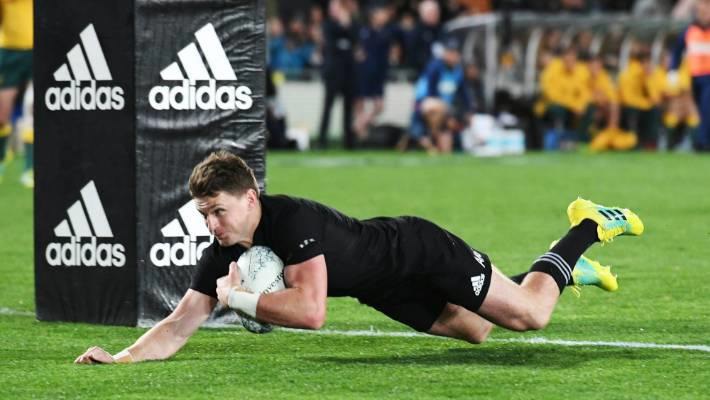
It was Beauden’s first test performance during the 2nd Test of the 2018 Bledisloe Cup against Australia, where he scored 4 magnificent tries , that truly showcased his flair and tenacity, securing the win for the All Blacks. An unstoppable Barret launched one creative kick after the other, ran through a tightly packed defensive line in zig-zag fashion and gave the Australian team a lesson in kick-and-chase styled rugby, securing the ball on the majority of bounces and leading to some of most memorable displays of running rugby ever recorded.
Description of Game
Barrett plays the majority of his rugby at flyhalf and is endowed with devastating speed (making him one of the quickest players in the All Blacks and the Hurricanes teams), a laser-like boot, and smart game management. Barrett’s pace has allowed him to perform several try-saving tackles on the opposition throughout his international career and has made him one of the highest try-scorers in rugby history. Barrett is also the co-highest try-scorer of any current All Blacks, with Ben Smith.
Barrett has a reputation of conjuring something out of nothing, the kind of player that can help his team claw their way back into a game against all odds. His ability to kick and chase down his own ball, with an even greater knack of securing the lucky bounce, is precisely what makes him such an unpredictable player. His ability to run the backline, break lines and handling wizardry is unmatched.
Dan The Man – Dan Carter
Background and Bio
(Correct as from 4 June 2020)
Daniel William Carter (ONZM) was born on 5 March 1982, in a small town, 10 minutes’ drive from the Carter family home in Southbridge, in the South Island of New Zealand, to Neville and Bev Carter. Dan has one older sister, Sarah. From the age of 5, he played with Southbridge Rugby Club as a scrum half for Ellesmere & Canterbury Country. He attended Ellesmere College where he played mostly at flyhalf and transferred to Christchurch Boys’ High School in his final year.
Carter plays for the Blues (Super Rugby) in New Zealand and played for New Zealand’s national team, the All Blacks. He is the highest point scorer in test rugby and is considered by many experts as the greatest flyhalf in the history of the game. He has won three Super Rugby titles with the Crusaders, and nine Tri-Nations and Rugby Championships with the All Blacks.
Carter injured his groin while doing kicking practice during the 2011 Rugby World Cup but was a key member of the 2015 Rugby World Cup-winning teams, becoming one of 20 players to have won multiple Rugby World Cups. In the 2015 Rugby World Cup Final against Australia, he kicked four penalties, two conversions and a drop goal, and was named the man of the match.
In June 2003, Carter made his All Blacks debut at age 21 in Hamilton, New Zealand, scoring 20 points against Wales. He was then capped against France in Christchurch, which the All Blacks won 31–23. Carter was included in New Zealand’s 2003 Rugby World Cup squad, where he first gained serious international attention. Although he has been an All Black since 2003, he only secured a permanent position as the flyhalf of the team during the 2004 tour to the United Kingdom and France.
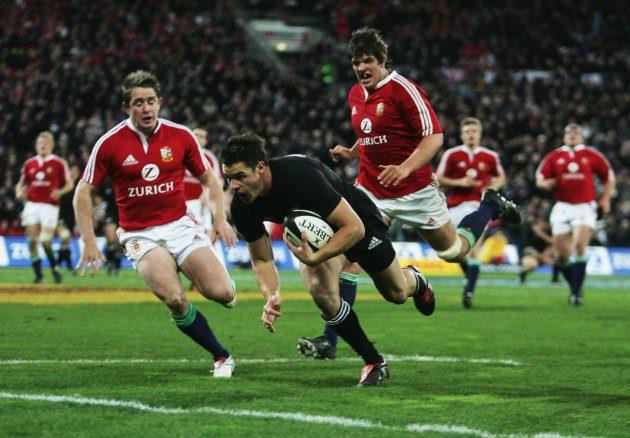
In 2005, Carter starred in the All Blacks 48–18 win over the British and Irish Lions. He scored two tries, five penalties, and four conversions. He ended the match with 33 points, passing the previous All Blacks record of 18 points in a Lions Test (Carter’s second-half total of 22 points by itself was sufficient to top this). The performance was later described by The Guardian17 as “the definitive fly-half display of the modern era”. On 27 November 2010, after scoring a halfway penalty against Wales, Carter became the highest point scorer of all time, overtaking England’s Jonny Wilkinson’s previous record of 1,178.
On 16 November 2013, Carter became the fifth All Black to play 100 caps when New Zealand beat England by 30–22 at Twickenham on their end of year tour. On 17 July 2015, Carter and Richie McCaw played their final match in Christchurch together. On 15 August 2015 Carter played his final test in New Zealand in the Bledisloe Cup decider at Eden Park, a trophy he has never lost since his debut.
In the 2015 Rugby World Cup Final against Australia, Carter scored four penalties, converted two tries (with the final one taken with his right foot), and kicked a drop goal that gave the All Blacks the winning moment and securing the IRB Player of the Year award for the third time.
Carter became engaged to his long-time girlfriend Honor Dillion in October 2010 and the couple got married on 9 December 2011 and has since then had three children. In November 2006, Carter released his book Dan Carter: Skills & Performance which includes stories about his international rugby career and skills for younger players.
Player Stats
Date of Birth: March 5, 1982, Leeston
Major Teams: Canterbury, Crusaders, Perpignan, Racing Metro, Blues, New Zealand.
Height: 5 ft 10 in / 178 cm (rounded).
Weight: 207 lb / 94 kg (rounded).
Game Stats – All Tests: (2003 – 2015)
Matches: 112
Starts: 106
As Substitute: 6
Points: 1,598
Tries: 29
Conversions: 293
Penalties: 281
Drop Goals: 8
Wins: 99
Losses: 12
Draws: 1
Win Percentage: 88.39%
Awards, Trophies and Accolades
World Player of the Year Award – 2005
World Player of the Year Award – 2012
World Player of the Year Award – 2015
Rugby World Cup Winner – 2011
Rugby World Cup Winner – 2015
Defining Moment
Carter was catapulted to a new level of excellence after he scored two tries, five penalties, and four conversions in the 2nd test against the 2005 British and Irish Lions Tour, ending the match with 33 points, smashing the previous All Blacks records. In a post-match comment Sir Graham Henry (KNZM)said of Carter, “He came of age that day” summing up Carter’s master-piece performance. Carter’s individual brilliance set the All Black team on fire, followed up with his display of running rugby and on-target kicks, secured an All Black victory. Interestingly Carter played this game against his opposite number 10, the equally talented, Jonny Wilkinson.
Description of Game
Dan Carter is hailed as being one of the best fly-halves in the world, and his reputation is lauded in both rugby hemispheres. He is a consistent kicker at goal, a master tactician, with an almost intuitive broken-field playing ability. Carter knows when to engage the power of the backline and is a fierce tackler, with a frightening ability to accelerate with great speed. That, in combination with a dangerous side-step, arguably makes Carter the possessor of the complete package.
One of Carter’s less praised abilities is his unwavering will to return from injury, which has plagued him all his career and important performances, on several occasions; many times, just before critical games. Having been benched a number of times as a result of last-minute injury, many important games have had to be played in his absence. It takes an exceptionally clear minded and goal orientated individual to come back from such trials and tribulations.
Carter is also acclaimed, worldwide, as a role model with an inspiring skill set making him an asset on and off the field. Part time underwear model, voted as one of the Top 10 sexiest male athletes, being able to play at No 12 – there seems to be little Dan the Man can’t do!
The Kicking Machine – Jonny Wilkinson
Background and Bio
(Accurate as of 5 September 2020)
Jonathan Peter Wilkinson, CBE, was born on 25 May 1979 at Frimley Park Hospital in Frimley, Surrey and grew up in Farnham. Jonathan’s brother, Mark, was also a Newcastle player, their father, Phil, was a rugby player and cricketer, and their mother, Philippa, played squash at county level. He attended Pierrepont School, Frensham and Lord Wandsworth College near Hook, Hampshire, and played at youth level for Farnham Rugby Club. He gained a place at the University of Durham but gave his place up in 1997 to become a professional rugby union player with the Newcastle Falcons.
He played fly-half for Newcastle Falcons and Toulon and represented England and the British and Irish Lions. He is particularly known for scoring the winning drop goal in the 2003 Rugby World Cup Final and is widely acknowledged as one of the best rugby players of all time. He played club rugby for twelve seasons in the English Premiership with Newcastle Falcons. In 2009 he moved to Toulon, where he won two Heineken Cups and one Top 14 championship in five seasons.
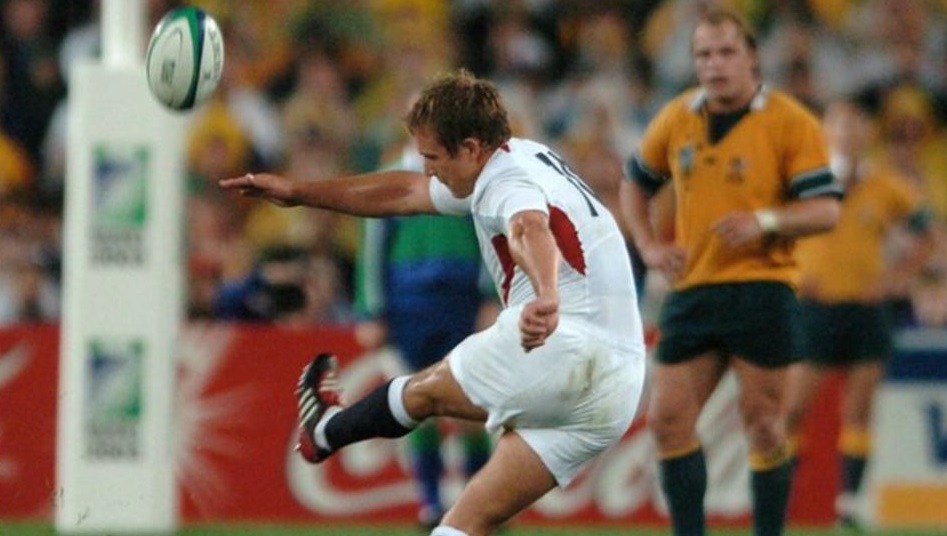
Wilkinson won 91 caps for England. He was an integral member of the England squad which won the 2003 World Cup, scoring the winning drop goal in the last minute of extra time against Australia in the final. He came back from several injuries and was part of the England team which reached the final of the 2007 World Cup. He toured twice with the British and Irish Lions, in 2001 to Australia and 2005 to New Zealand, winning 6 caps.
Injury forced him to miss out on the 2010 autumn internationals, in the process losing his position as the all-time leading points scorer in test rugby to Dan Carter. However, Wilkinson reclaimed the record during the 2011 Six Nations Championship, a tournament during which he came off the bench in each of England’s five games. He again lost the record to Carter in July 2011. On 12 December 2011, he announced his retirement from Test Rugby.
He retired from rugby after the end of the 2013–14 season. In 2016, he was inducted into the World Rugby Hall of Fame. Wilkinson is currently a studio analyst for ITV Sport, working on their coverage of the Six Nations Championship, Rugby World Cup, and other rugby events. In May 2014, Wilkinson announced that he would retire from all rugby at the end of the season.
He wrote a column for The Times occasionally until 2011, often during periods of high media focus on rugby, such as Six Nations tournaments and Rugby World Cups. He has also written five books. Wilkinson’s book, Tackling Life, was released in 2008. The book focuses on how his view on life changed after his injury woes, and how he overcame them. His fifth book, Jonny: My Autobiography was released in 2011.